Notes & Insights
Notes & Insights
July 2026
Technical Note
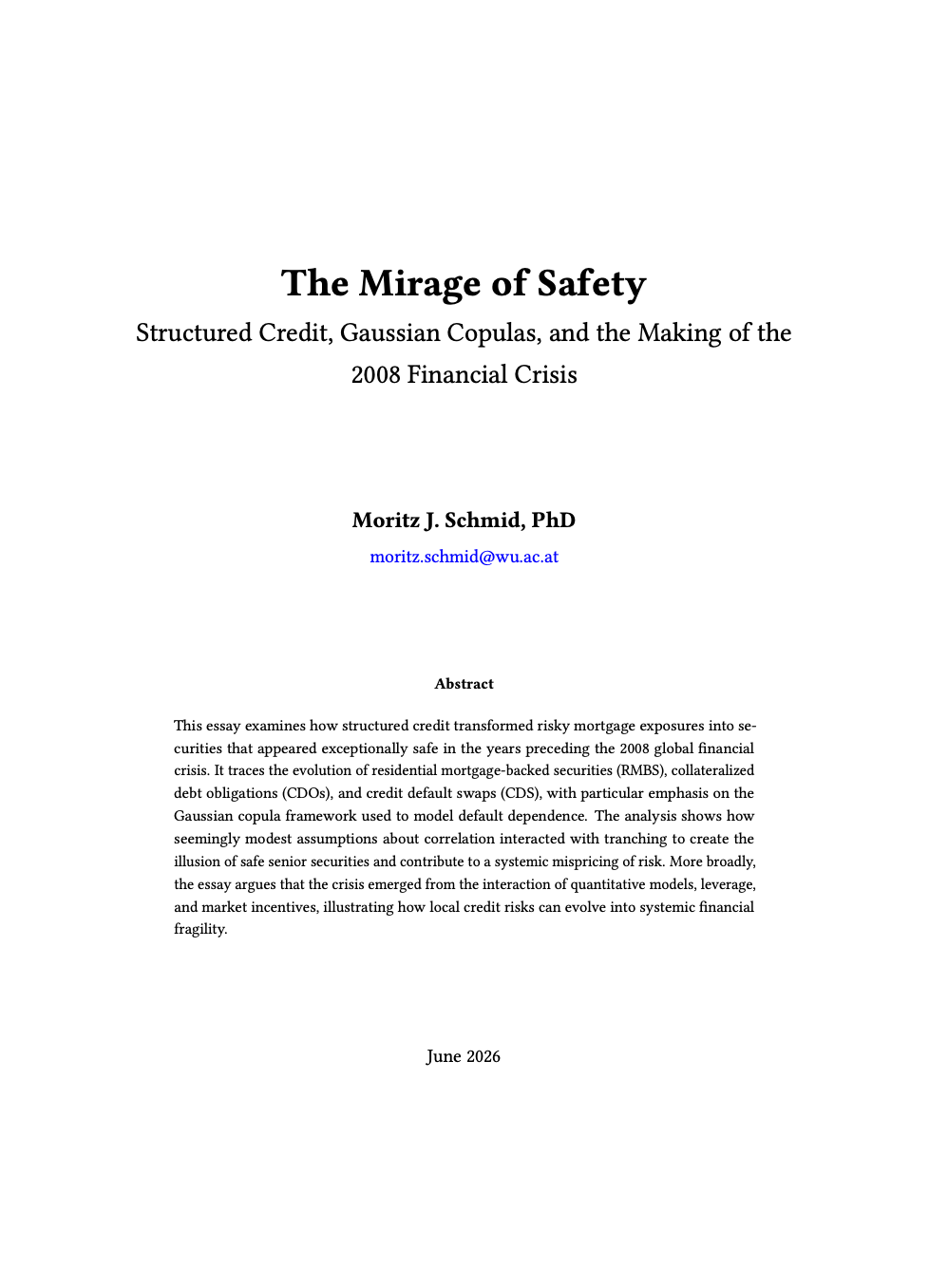
Covariance-First Simulation of Gaussian Processes
This technical note develops a covariance-first view of Gaussian-process simulation for quantitative finance. The central idea is that Monte Carlo path generation is not merely about drawing random numbers, but about constructing paths with the correct variance, covariance, and temporal dependence structure. The Karhunen–Loève expansion provides a natural framework for this task by decomposing a covariance kernel into orthogonal directions of variation and assigning independent Gaussian coefficients to those directions. The note derives the expansions of Brownian motion and the Brownian bridge on [0,1], connects them to finite-dimensional covariance-matrix decompositions, and validates the resulting simulations numerically. The aim is to show how a single covariance-based principle links stochastic-process theory, numerical linear algebra, and practical simulation in financial Monte Carlo.
June 2026
Essay
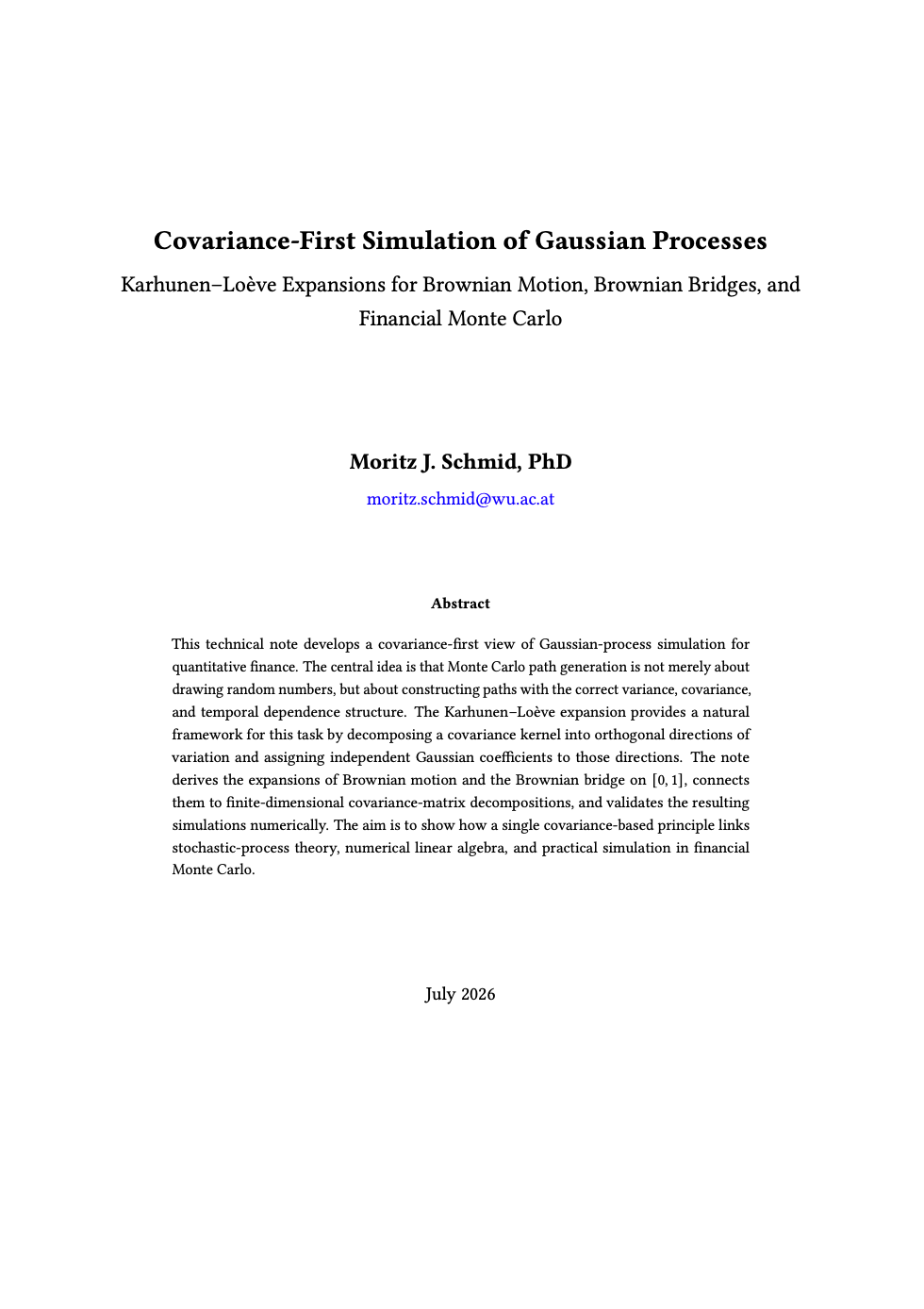
The Mirage of Safety: Structured Credit, Gaussian Copulas, and the Making of the 2008 Financial Crisis
This essay examines how structured credit transformed risky mortgage exposures into securities that appeared exceptionally safe in the years preceding the 2008 global financial crisis. It traces the evolution of residential mortgage-backed securities (RMBS), collateralized debt obligations (CDOs), and credit default swaps (CDS), with particular emphasis on the Gaussian copula framework used to model default dependence. The analysis shows how seemingly modest assumptions about correlation interacted with tranching to create the illusion of safe senior securities and contribute to a systemic mispricing of risk. More broadly, the essay argues that the crisis emerged from the interaction of quantitative models, leverage, and market incentives, illustrating how local credit risks can evolve into systemic financial fragility.