Research
Publications &
Working Papers
June 2026
Peer-Reviewed Article
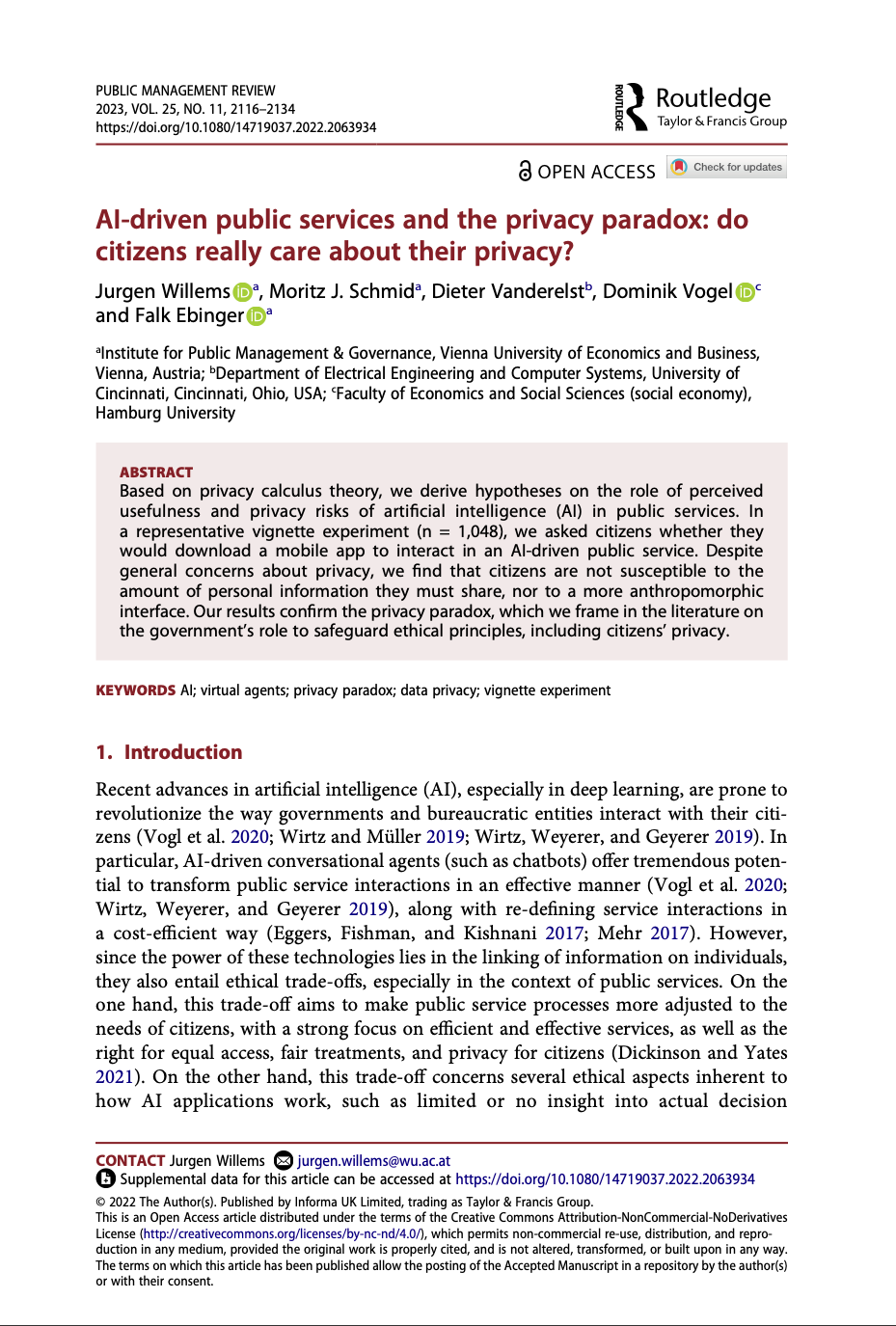
AI for integrity: Predicting public servants’ susceptibility to corruption via supervised machine learning
with Jurgen Willems
Government Information Quarterly
Volume 43, Issue 3
Public corruption undermines government performance, erodes trust, and fuels illiberal populism. Using a large, globally stratified dataset of 18,277 public servants across 90 countries, this article compares a conventional regression baseline with five supervised machine learning models to predict susceptibility to corruption. The results show that democratic values, beliefs about competition, and attitudes towards leadership are more consistently predictive than socio-economic characteristics such as income, education, or gender, highlighting the value of machine learning for studying integrity risks.
December 2025
Peer-Reviewed Article
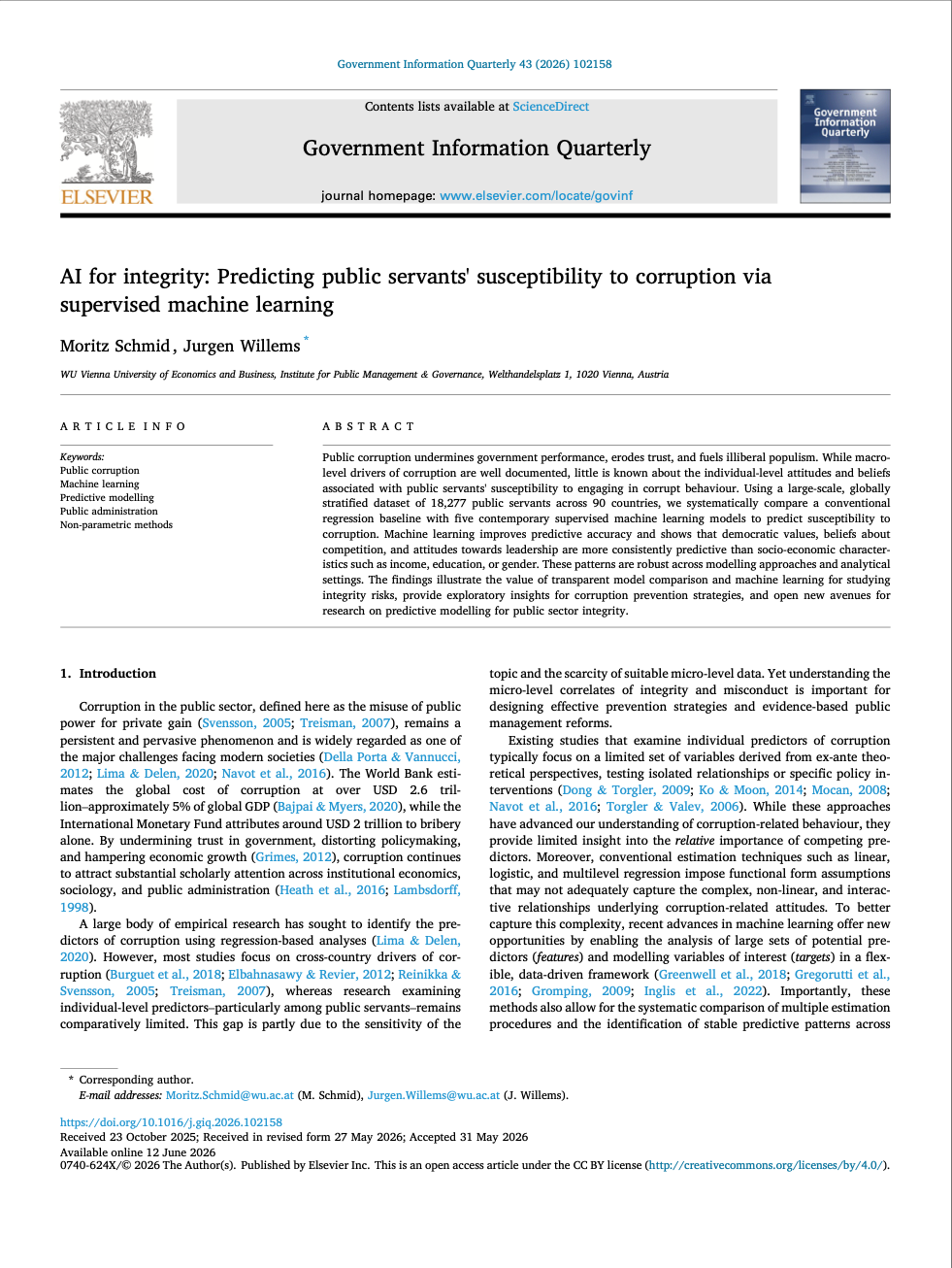
Opening the Black Box of Nonprofit Reputation and Volunteer Attraction With Supervised Machine Learning
with Hannes W. Lampe & Jurgen Willems
Nonprofit Management & Leadership
This article explores the potential of machine learning for nonprofit research by comparing traditional linear regression with four supervised machine learning approaches. Using two data sources and 56 predictors, we model both reputation ratings and the total number of volunteers for 4,021 U.S. nonprofit organizations. The results show a clear predictive advantage of machine learning models, especially Random Forests and (Extreme) Gradient Boosting, and suggest that financial indicators and governance practices are particularly important for predicting organizational reputation.
May 2025
Peer-Reviewed Article
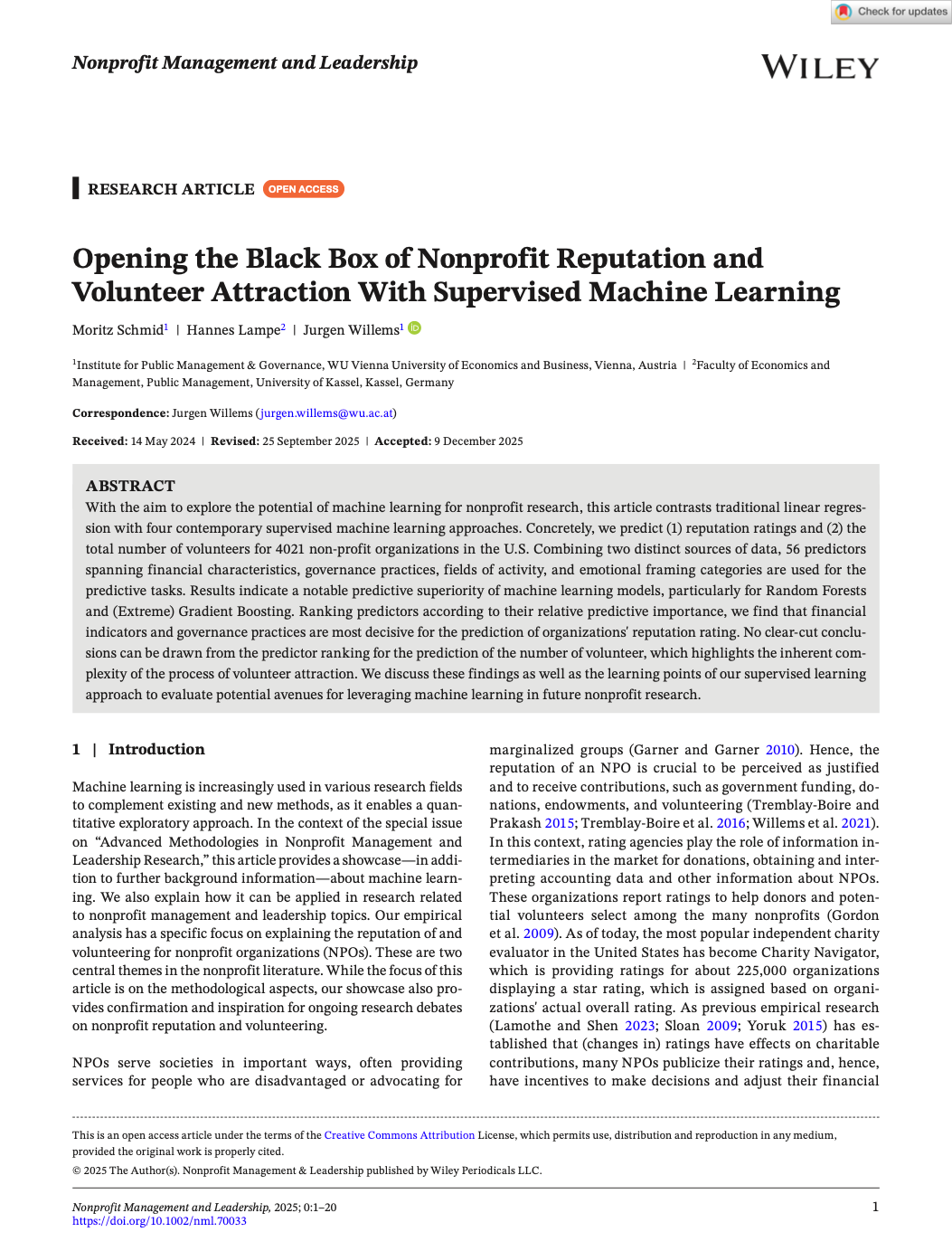
What Parents Want – Applying Machine Learning to Predict Preferences and Support for School Choice Policies in K-12 Education
with Fredrik O. Andersson & Jurgen Willems
Journal of School Choice
Volume 20, 2026 – Issue 1
School choice policies allow parents to act on their preferences when choosing a school for their child(ren), but they can also create planning challenges for policymakers. Using survey data from 4,574 respondents, this article compares logistic regression with five machine learning algorithms to better understand parental school preferences and support for school choice policies. The results show a predictive advantage of machine learning models and identify attitudes toward time spent on standardized tests and school funding as the most decisive predictors.
April 2022
Peer-Reviewed Article
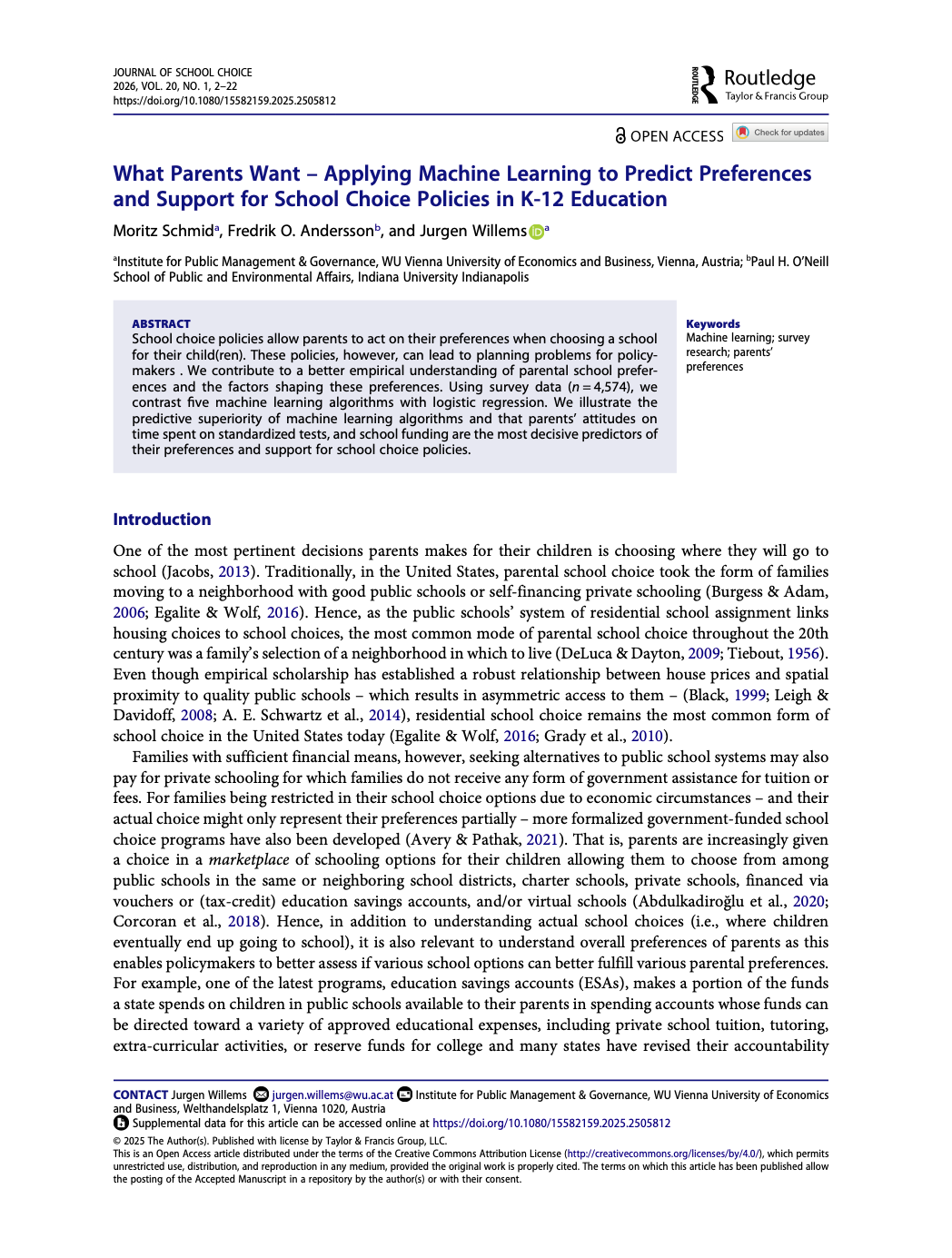
AI-driven public services and the privacy paradox: do citizens really care about their privacy?
with Jurgen Willems, Dieter Vanderelst, Dominik Vogel, and Falk Ebinger
Public Management Review
Volume 25, 2023 – Issue 11
Based on privacy calculus theory, we derive hypotheses on the role of perceived usefulness and privacy risks of artificial intelligence (AI) in public services. In a representative vignette experiment (n = 1,048), we asked citizens whether they would download a mobile app to interact in an AI-driven public service. Despite general concerns about privacy, we find that citizens are not susceptible to the amount of personal information they must share, nor to a more anthropomorphic interface. Our results confirm the privacy paradox, which we frame in the literature on the government’s role to safeguard ethical principles, including citizens’ privacy.